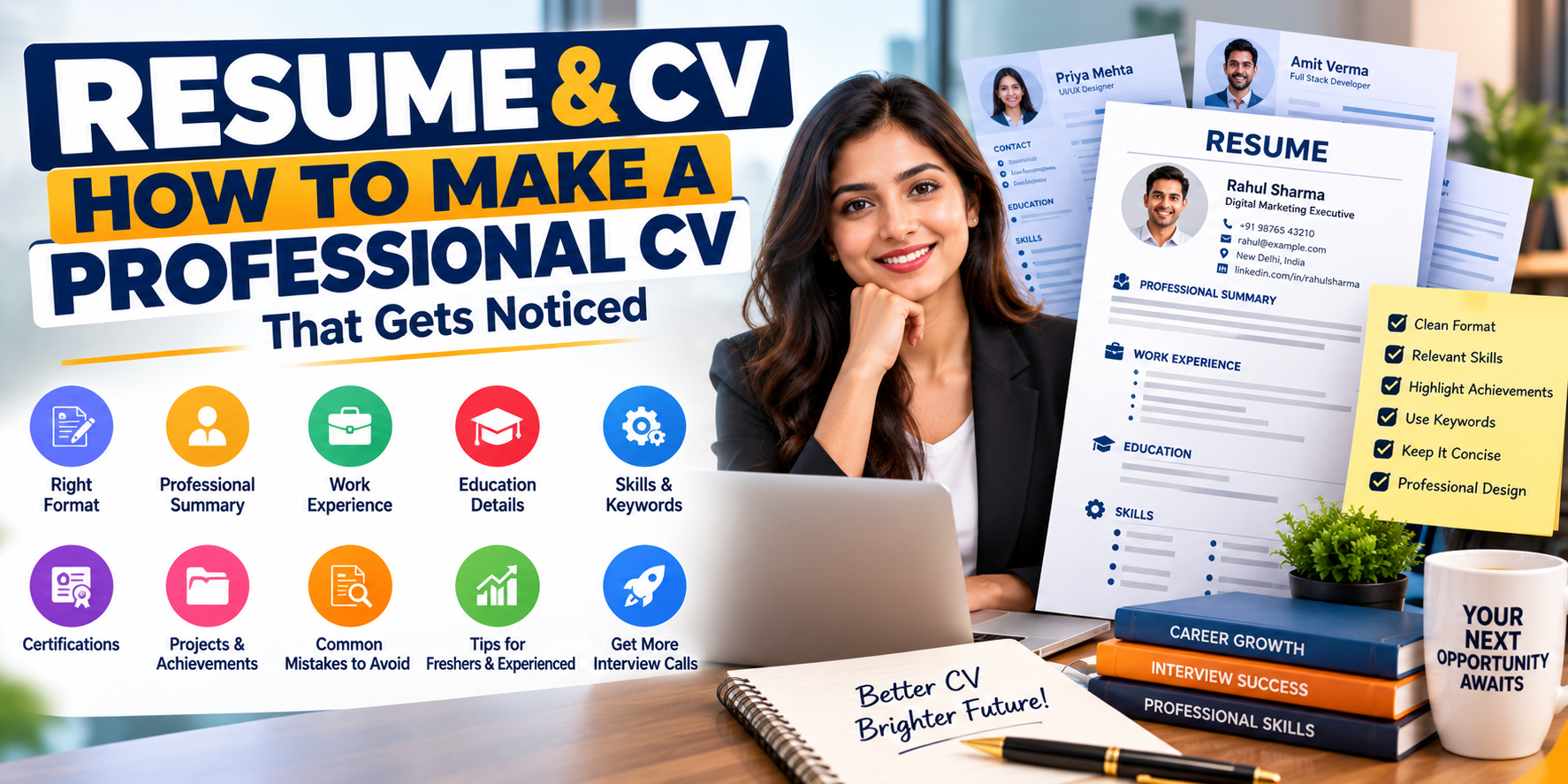
Resume & CV: How to Make a Professional CV That Gets Noticed
A CV is often the first impression an employer gets from you.
Before a recruiter speaks to you, checks your work or invites you for an interview, they may first see your CV. That means a well-written CV can help you get noticed, while a poorly organised one can make it difficult for a recruiter to understand what you can actually offer.
Many candidates think a professional CV needs to look complicated. It doesn't.
A good CV is usually simple, clear and focused on the job you're applying for. It should quickly tell the employer who you are, what you have done, what skills you have and why you could be a good fit for the position.
Whether you're a fresher looking for your first job, an experienced professional planning a career move or someone changing industries, the basic principles remain similar.
The key is to present your information in a way that is easy to read and relevant to the employer.
What is a CV?
A CV, or Curriculum Vitae, is a document that presents your professional background.
It can include your:
- Contact information
- Professional summary
- Work experience
- Education
- Skills
- Certifications
- Projects
- Achievements
- Languages
- Relevant professional information
A resume is generally shorter and more targeted toward a particular job, while the term CV can sometimes refer to a more detailed record of academic and professional experience. In everyday job applications, however, the terms are often used interchangeably.
The important thing isn't whether the file is called a “CV” or “resume.”
What matters is whether the document clearly communicates your suitability for the job.
Why a professional CV is important
Recruiters often review a large number of applications.
They don't necessarily have time to read every CV word by word. A clear structure helps them find important information quickly.
Imagine a recruiter is hiring a digital marketing executive.
They may immediately want to know:
- Does the candidate have digital marketing experience?
- Which platforms have they worked with?
- Do they understand Google Ads or Meta Ads?
- What results have they achieved?
- What qualifications do they have?
- How long have they worked in the field?
If these details are hidden inside long paragraphs, the recruiter has to work to find them.
A professional CV makes the information easy to scan.
That is one of the biggest differences between a basic CV and a strong CV.
1. Start with a clean CV format
Before writing the content, choose a professional layout.
A good CV should have enough white space and a clear visual hierarchy.
Use:
- Clear section headings
- Consistent font sizes
- Short paragraphs
- Bullet points
- Proper spacing
- Simple formatting
- Consistent alignment
Avoid using too many colours, decorative graphics or unusual fonts unless you're applying for a creative role where a portfolio-style CV is genuinely appropriate.
For most jobs, a clean and professional design works better.
Recommended CV structure
A simple structure could be:
- Name
- Contact information
- Professional Summary
- Work Experience
- Education
- Skills
- Certifications
- Projects
- Achievements
- Additional Information
You don't necessarily need every section. Choose the sections that are relevant to your experience and the position.
2. Put your name and contact details at the top
Your name should be easy to find.
Under your name, include the information an employer needs to contact you.
Example
Rahul Sharma
Digital Marketing Executive
Delhi, India
Phone: +91 XXXXX XXXXX
Email: rahul@example.com
LinkedIn: linkedin.com/in/rahulsharma
You can also include a professional portfolio or website if relevant.
Make sure your email address looks professional.
An email such as:
is generally better for job applications than an informal address such as:
You don't need to include unnecessary personal information.
In many modern CVs, details such as your full residential address, father's name, marital status or religion are unnecessary unless specifically required for a particular application.
3. Write a strong professional summary
The professional summary is one of the most important parts of a CV.
It should give the recruiter a quick understanding of your background.
Avoid generic statements such as:
“I am a hardworking and dedicated person looking for a challenging opportunity where I can utilise my skills.”
This type of statement doesn't tell the employer much.
Instead, be specific.
“Digital marketing professional with 4+ years of experience in Google Ads, Meta Ads, SEO and lead-generation campaigns. Experienced in managing performance campaigns, analysing customer acquisition data and developing strategies to improve qualified leads and conversion rates.”
A good summary can mention:
- Your job title or professional area
- Years of experience
- Key skills
- Industry experience
- Major area of responsibility
- A relevant strength or achievement
For freshers, the summary can focus on education, skills, projects and career interests.
4. Focus on achievements, not only responsibilities
This is one of the most important CV-writing rules.
Many candidates write their experience like this:
Digital Marketing Executive
- Managed social media accounts
- Created campaigns
- Worked on SEO
- Managed Google Ads
- Generated reports
These statements describe responsibilities, but they don't show the impact of the work.
A stronger version could be:
- Managed Google and Meta advertising campaigns for multiple business accounts.
- Improved qualified lead generation through campaign optimisation and audience testing.
- Conducted keyword research and SEO analysis to improve organic visibility.
- Monitored campaign performance and prepared monthly performance reports.
If you have measurable results, include them.
- Increased qualified leads by 35% within six months.
- Reduced average cost per lead by 22%.
- Managed monthly advertising budgets of more than ₹5 lakh.
- Improved organic website traffic by 40% over 12 months.
Numbers give employers a better understanding of your contribution.
Don't invent numbers just to make a CV look impressive. Use figures only when they are accurate.
5. Use the right keywords
Many companies use applicant tracking systems, commonly called ATS, to help manage job applications.
These systems may scan CVs for information relevant to a job description.
For example, if a company is hiring a software developer and the job description mentions:
- Java
- Spring Boot
- MySQL
- REST API
- Git
- AWS
and you genuinely have those skills, using the relevant terminology in your CV can make your experience easier to identify.
The important point is to use keywords naturally.
Don't add a long list of technologies you don't know simply because they appear in the job description.
Your CV should accurately represent your experience.
6. Tailor your CV for the job
One CV doesn't always need to be sent to every employer.
Suppose you're applying for two positions:
Job A: Digital Marketing Manager
You might emphasise:
- Campaign management
- Team leadership
- Marketing strategy
- Budget management
- Customer acquisition
- Performance reporting
Job B: SEO Specialist
You might emphasise:
- Technical SEO
- Keyword research
- On-page optimisation
- Link building
- Search Console
- Analytics
- Organic traffic growth
The experience hasn't changed.
You're simply presenting the most relevant parts more prominently.
This makes your application more targeted.
7. Explain your work experience clearly
For each job, use a consistent structure.
Example
Digital Marketing Executive
ABC Technologies, Delhi
January 2023 – Present
- Managed paid advertising campaigns across Google and Meta.
- Developed lead-generation campaigns for B2B clients.
- Monitored campaign performance and optimised budgets.
- Worked with the content team on SEO and landing-page improvements.
- Prepared monthly performance reports for management.
If you have several years of experience, you don't need to provide extremely detailed information about every position you've ever held.
Focus more attention on recent and relevant roles.
Older positions can be described more briefly.
8. Freshers should focus on skills and projects
If you don't have professional experience, don't worry about leaving a large empty section.
Freshers can create a strong CV by highlighting:
- Education
- Academic projects
- Internships
- Certifications
- Technical skills
- Volunteer work
- Freelance work
- Personal projects
- Achievements
E-commerce Website Project
- Developed a responsive e-commerce website using React and Node.js.
- Implemented product listing, search and shopping-cart functionality.
- Created REST APIs for user and product management.
- Used MySQL for database management.
This gives an employer evidence of practical skills even without full-time employment.
9. Choose skills carefully
Don't fill your CV with every skill you have ever heard of.
Separate skills into useful categories when appropriate.
Technical Skills
- Python
- Java
- React
- Laravel
- MySQL
- AWS
- Git
Marketing Skills
- Google Ads
- Meta Ads
- SEO
- Email Marketing
- Analytics
- Content Marketing
Professional Skills
- Communication
- Project Management
- Team Collaboration
- Problem Solving
- Client Management
Most importantly, make sure the skills match your actual ability.
A recruiter may ask about any skill listed on your CV during an interview.
10. Education should be easy to find
Education is particularly important for students and freshers.
Example
Bachelor of Technology in Computer Science
XYZ University, Delhi
2022
You can include your percentage or CGPA if it strengthens your application.
For experienced professionals, education generally doesn't need to occupy as much space as work experience unless the qualification is particularly relevant to the position.
11. Include certifications when they matter
Certifications can strengthen a CV, particularly in industries where skills change quickly.
Examples include certifications related to:
- Digital marketing
- Cloud computing
- Data analytics
- Cybersecurity
- Project management
- Finance
- Software development
- Industry-specific tools
Don't add certifications simply to make the CV longer.
A relevant certification is more useful than ten unrelated certificates.
12. Keep the CV concise
A professional CV doesn't need to contain your entire life story.
For many candidates, one or two pages is enough.
The correct length depends on experience and industry.
A fresher may be able to present everything important on one page.
An experienced professional with 10–15 years of relevant experience may reasonably need two or more pages.
Include information because it is useful, not because you need to fill space.
If a sentence doesn't help the employer understand your qualifications, consider removing it.
13. Use professional language
Your CV should be confident without sounding exaggerated.
Avoid phrases such as:
- “I am the best employee.”
- “I am extremely talented.”
- “I can do anything.”
- “I am a perfect candidate.”
Instead, show your capabilities through evidence.
Instead of:
“Excellent sales professional.”
Write:
“Generated ₹40 lakh in annual sales through B2B client acquisition and account development.”
Specific information is more convincing than self-praise.
14. Avoid common CV mistakes
Some mistakes can make an otherwise good CV look unprofessional.
Spelling and grammar errors
Always proofread your CV. A recruiter may interpret repeated errors as a lack of attention to detail.
Too much personal information
Don't overload the CV with unnecessary personal details.
Unprofessional email address
Use a simple professional email.
Huge paragraphs
Recruiters need to scan the document quickly. Use short sections and bullet points.
Too many colours
Keep the design professional and readable.
False information
Never exaggerate qualifications, job titles or achievements.
Generic CV for every job
Adjust your CV to the position when possible.
Unnecessary objective statement
If your professional summary already explains your career direction, you don't need a separate generic objective.
Poor file naming
Instead of:
resume-final-new-latest2.pdf
use something like:
Rahul_Sharma_Digital_Marketing_CV.pdf
It looks more professional and is easier for recruiters to identify.
15. Should you include a photograph?
Whether you should include a photograph depends on the country, industry and employer.
For many professional applications, particularly where an ATS is involved, a photograph isn't necessary unless requested.
In some markets and industries, photographs may still be commonly used.
The safest approach is to follow the requirements of the employer and the specific job application.
If a photo is required, use a professional headshot rather than a casual social-media picture.
16. Save your CV as a PDF
Once your CV is complete, PDF is generally a good format for sharing because it preserves the layout across devices.
Before sending it, open the PDF on both a computer and phone if possible.
Check:
- Are all pages displaying correctly?
- Are headings aligned?
- Are links working?
- Are there spelling mistakes?
- Are there strange symbols?
- Is the text readable?
- Is the file name professional?
A CV that looks perfect in an editing program can sometimes look different after exporting.
17. Create a professional LinkedIn profile
Your CV and LinkedIn profile should tell a consistent professional story.
If your CV says you are a digital marketing specialist but your LinkedIn profile lists completely different roles and skills, it can create confusion.
Make sure your LinkedIn profile includes:
- Professional headline
- Updated work experience
- Skills
- Education
- Certifications
- Relevant projects
- Professional photograph
- Portfolio or website where appropriate
You can include the LinkedIn URL on your CV.
18. Build your CV around the employer's needs
The strongest CV isn't necessarily the one with the most information.
It's the one that answers the employer's questions quickly.
Before applying, read the job description carefully.
What problem is this company trying to solve by hiring someone?
If the company needs a salesperson, show sales experience.
If it needs a developer, show technical projects and development experience.
If it needs an accountant, highlight accounting software, financial reporting and relevant qualifications.
Your CV should make it easy for the recruiter to connect your experience with the requirements of the job.
A simple professional CV structure
-
Name and contact details
Keep this section clear and professional.
-
Professional summary
Two to four lines explaining who you are and what you bring.
-
Work experience
List relevant positions in reverse chronological order, with achievements and responsibilities.
-
Education
Add your relevant qualifications.
-
Skills
List the skills that matter for the target role.
-
Certifications
Include relevant professional certifications.
-
Projects
Particularly useful for freshers, developers, designers and career changers.
-
Additional information
Include languages, publications, volunteer work or other relevant information when appropriate.
Final CV checklist
Before sending your CV, ask yourself:
- Is my name clearly visible?
- Is my contact information correct?
- Does my professional summary explain my background?
- Is my most relevant experience easy to find?
- Have I included measurable achievements where possible?
- Are my skills relevant to the job?
- Have I removed unnecessary information?
- Is the spelling and grammar correct?
- Is the formatting consistent?
- Is the CV easy to read on a phone?
- Have I used relevant keywords naturally?
- Is the file saved as a professional PDF?
- Is the file name professional?
- Does the information match my LinkedIn profile?
- Have I checked the job description before submitting?
Final thoughts
A professional CV doesn't need to be flashy. It needs to be clear, relevant, accurate and easy to understand.
Think of your CV as a short introduction to your professional value. The recruiter should be able to understand your background, skills and achievements without having to search through pages of unnecessary information.
For experienced professionals, the focus should be on results and relevant experience. For freshers, education, projects, internships, certifications and practical skills can demonstrate potential. For people changing careers, transferable skills and relevant projects can help connect previous experience with the new direction.
Most importantly, don't treat your CV as a document that you create once and never change.
Update it when you gain a new skill, complete a major project, receive a certification or achieve an important result. When you apply for a specific position, adjust the emphasis to match what that employer is actually looking for.
A well-prepared CV won't guarantee an interview, but it can make your qualifications much easier to see.
And sometimes, that's the difference between an application being overlooked and a recruiter deciding to learn more about you.
Comments
Leave a Comment