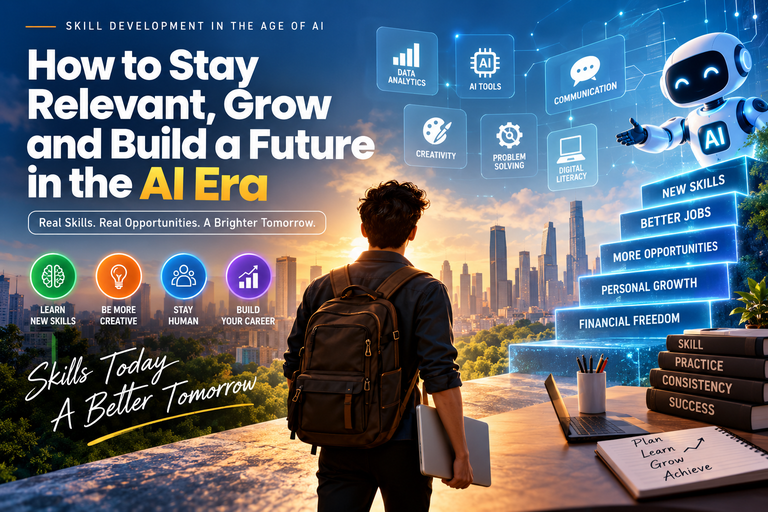
Introduction: The Question Everyone Is Asking
A few years ago, learning a new skill often meant taking a course, getting a certificate and adding it to your resume.
Today, things are moving much faster.
AI can write code, create images, summarize reports, analyze spreadsheets, generate presentations, translate languages and help people learn almost anything. Tools that once required years of technical experience are becoming accessible to ordinary users.
That creates an uncomfortable question:
If AI can do so much, what should humans learn?
The answer is more interesting than simply learning how to use the latest AI tool.
The people who benefit from AI are likely to be those who understand their own field, know how to use technology and can still think independently. A marketer who understands customers and knows how to use AI for research has an advantage over someone who only knows how to generate prompts.
A developer who understands software architecture can use AI coding assistants far more effectively than someone who depends on generated code without understanding it.
This is why skill development matters more than ever.
The goal is not to collect dozens of certificates. It is to become useful in situations where technology, judgment and human understanding have to work together.
1. AI Is Changing the Meaning of a "Job Skill"
For a long time, professional skills were relatively stable.
A graphic designer needed design software. An accountant needed accounting knowledge. A content writer needed research and writing ability. A programmer needed programming languages.
Those fundamentals still matter, but the way people use them is changing.
Imagine a content writer who once spent three hours researching a topic, another two hours creating an outline and several more hours drafting an article. AI can now speed up parts of that process considerably.
But the writer still has to decide:
- Is the information accurate?
- Does the article answer the reader's actual question?
- Does it sound natural?
- Is the argument useful?
- What should be removed?
- What experience or insight can a human add?
The technology changes the workflow, but judgment remains important.
The same pattern appears across industries.
AI can help with tasks. People still have to understand the problem those tasks are solving.
That is why future-ready skill development should combine technical knowledge, digital fluency and human judgment.
2. Digital Literacy Is Becoming a Basic Career Skill
You do not need to become an AI engineer to work effectively in an AI-powered workplace.
You do, however, need a reasonable understanding of digital tools.
Digital literacy means knowing how to work with software, online platforms, data, cloud applications, AI assistants and digital communication systems.
For students, this might mean learning productivity tools, research methods, spreadsheets and AI-assisted learning.
For employees, it may involve understanding workplace automation, analytics dashboards, CRM systems or AI-powered software.
For business owners, digital literacy can mean knowing how websites, online advertising, automation, analytics and AI tools fit together.
The important part is curiosity.
When a new tool appears, instead of asking, "Will this replace my job?" ask:
"What parts of my work could this make easier, faster or better?"
That question leads to experimentation rather than fear.
3. Learn AI as a Tool, Not as a Shortcut
One of the most useful skills to develop today is AI literacy.
This does not mean memorizing complicated technical terminology.
It means understanding what AI can do, where it can make mistakes and how to give it useful instructions.
For example, someone working in marketing could use AI to brainstorm campaign ideas, organize customer research, create content variations and analyze large amounts of text.
But they should still understand marketing.
AI can generate ten advertising headlines in seconds. It cannot automatically know which headline fits your brand, customer and business situation unless you provide the right context and evaluate the result.
That is where human expertise becomes important.
A good AI user develops three simple habits:
- Ask clearly.
- Check carefully.
- Improve intelligently.
The first output should rarely be treated as the final answer.
Use AI as a working partner. Give it context. Challenge its suggestions. Correct mistakes. Add your own experience.
That approach builds a much stronger skill than simply learning a collection of prompts.
4. Communication May Become Even More Valuable
When technology makes information easier to produce, communication becomes more important.
A person who can explain a complicated idea clearly can be valuable in almost any organization.
Good communication includes writing emails that people understand, presenting ideas, listening properly, explaining technical subjects to non-technical people and handling difficult conversations.
Consider two employees.
Both have access to the same AI tools. Both can create reports quickly.
One sends a complicated 20-page document with no clear recommendation.
The other creates a short explanation that tells the manager what happened, why it matters and what decision needs to be made.
The second person may create more value even though both have access to exactly the same technology.
AI can help produce information.
People still have to communicate what that information means.
5. Creativity Still Needs Practice
There is a common misconception that AI makes creativity unnecessary.
In reality, AI can make creativity more accessible while also raising expectations.
When everyone can generate an image in seconds, simply generating an image becomes less impressive.
When everyone can create a basic article, the quality of the idea matters more.
When everyone can produce a video script, the story, perspective and emotional connection become more important.
This is why creative skills deserve serious attention.
Learn photography. Write. Draw. Make videos. Experiment with design. Study storytelling. Build websites. Create small projects.
You do not need to become a professional artist.
Creative practice teaches you to notice details, combine ideas and see possibilities that are not immediately obvious.
Those habits are useful far beyond creative industries.
6. Problem-Solving Is a Skill Worth Building
AI is very good at producing answers.
That makes the ability to identify the right problem even more valuable.
Suppose a company's website receives traffic but very few visitors become customers.
Someone might immediately ask AI to write better website content.
But the actual problem could be something else.
Maybe the pricing is unclear. Perhaps the checkout process is difficult. Maybe customers do not trust the company. Maybe the traffic is coming from the wrong audience.
A strong problem solver investigates before choosing a solution.
- Ask questions.
- Examine evidence.
- Test possible explanations.
- Decide what needs to change.
AI can support this process, but the human still needs to frame the problem correctly.
That is why problem-solving should be part of every person's skill development plan, regardless of their profession.
7. Data Skills Are Becoming Useful in Almost Every Industry
You do not have to become a data scientist to benefit from learning about data.
Basic data skills can help you make better decisions.
Learn how to read a spreadsheet. Understand percentages. Know what averages and trends mean. Learn how to create simple charts. Understand the difference between correlation and causation.
If you run a business, learn how to read sales and advertising data.
If you work in marketing, understand conversion rates and customer acquisition costs.
If you manage a website, learn how to interpret traffic and engagement.
If you are a student, learn how to organize research and evaluate evidence.
The goal is simple: become comfortable enough with data that numbers do not intimidate you.
AI can analyze huge amounts of information, but someone still needs to decide which numbers matter.
8. Learn to Ask Better Questions
One underrated skill in the AI era is asking good questions.
This applies to AI systems, colleagues, teachers, customers and managers.
A vague question usually produces a vague answer.
A useful question provides context.
Instead of asking:
"How do I improve my business?"
A better question might be:
"I run a small online clothing store. Most visitors come from Instagram, but very few complete purchases. What information should I examine to identify where customers are dropping out?"
The second question creates something to work with.
The same principle applies to learning.
Instead of searching for "learn coding," decide what you actually want to build.
- Create a website
- Build an app
- Automate a business process
- Analyze data
A specific goal gives your learning direction.
9. Build Projects Instead of Collecting Certificates
Certificates can be useful, especially when an employer or institution requires them.
But a certificate alone does not necessarily show what you can do.
Projects provide evidence.
- Build a website if you want to learn web development.
- Create a campaign plan if you want to learn digital marketing.
- Create a dashboard if you want to learn data analysis.
- Build a portfolio if you want to learn graphic design.
- Create an automated workflow if you want to learn AI automation.
Projects force you to deal with real problems.
Tutorials rarely mention every issue you encounter when building something yourself. That struggle is part of learning.
Your first project may be messy.
That is fine.
Your second will probably be better.
10. Soft Skills Are Not Going Away
Technical skills get a lot of attention because they are easier to list.
Soft skills are harder to measure, but they affect everyday work.
- Reliability
- Listening
- Teamwork
- Time management
- Empathy
- Accepting feedback
A person who constantly misses deadlines can create problems even if they have excellent technical knowledge.
Someone who cannot work with a team may struggle even if they are highly skilled individually.
As workplaces use more automation, human interaction does not disappear. In many cases, collaboration becomes more important because people have to coordinate technology, decisions and responsibilities.
11. Learn How to Learn
This may be the most useful skill of all.
Technology changes too quickly for anyone to finish learning.
A programming language can change. A marketing platform can change its algorithm. A design tool can introduce new AI features. An entire job role can evolve.
If you only know one fixed method, change becomes difficult.
If you know how to learn, change becomes manageable.
Build a simple learning routine.
Spend some time every week exploring something related to your field. Read documentation. Watch a practical tutorial. Take notes. Try the technique yourself.
More importantly, teach yourself through projects.
You do not need to spend four hours every day studying.
Consistent learning over months can produce a surprisingly large difference.
12. Students Need to Think Beyond Exams
Students entering the workforce today are growing up in a very different environment.
Academic knowledge remains important, but practical ability can make the transition into employment easier.
- A business student could learn digital marketing and analytics.
- A computer science student could build applications rather than only completing classroom assignments.
- A commerce student could learn spreadsheets, financial modeling and business software.
- A design student could experiment with AI-assisted creative workflows while strengthening traditional design principles.
The idea is not to turn every student into a technology expert.
It is to encourage students to connect classroom knowledge with practical work.
A portfolio can tell a future employer what a student has actually tried.
13. Professionals Should Audit Their Skills Regularly
If you already have a job, you do not need to start your career again.
Instead, look at your current role.
Write down the tasks you perform regularly.
Then divide them into three groups:
- Tasks that require human judgment.
- Tasks that can be supported by technology.
- Tasks that could potentially be automated.
This simple exercise can reveal where you should focus your learning.
For example, a sales professional may spend less time manually preparing reports and more time analyzing customer needs.
An accountant may automate repetitive spreadsheet work and spend more time interpreting financial information.
A content professional may use AI for research and first drafts while focusing more heavily on editing, strategy and audience understanding.
The goal is to move toward work where your judgment adds value.
14. Entrepreneurs Need a Different Kind of Skill Stack
Business owners have a unique opportunity because AI can reduce the cost of many business activities.
A small team can now access tools for content creation, customer support, research, design, analytics and automation.
But technology does not remove the need for business fundamentals.
Entrepreneurs still need to understand customers, pricing, sales, cash flow and operations.
A founder who learns both business fundamentals and modern digital tools can experiment faster.
For example, instead of spending weeks preparing a basic marketing concept, a business owner can use AI to generate several possibilities, test them and spend more time studying customer response.
Speed can help, but judgment determines where that speed should be used.
15. Human Skills Become More Valuable When Technology Gets Better
There is an interesting effect that happens whenever technology improves.
Some tasks become easier.
As those tasks become easier, people start expecting more.
Think about photography.
Smartphones made it possible for almost everyone to take decent photographs. That did not make professional photography meaningless. It changed what people expected from professionals.
The same pattern can happen with AI.
If everyone can produce basic content, customers may expect more original ideas.
If everyone can create basic designs, brands may care more about identity and strategy.
If everyone can generate code, understanding architecture and user requirements may become more important.
The baseline rises.
That means skill development should not stop when a tool becomes available.
It should evolve with the tool.
16. A Practical Skill Development Roadmap
If you are unsure where to begin, use a simple roadmap.
Month 1: Digital Foundations
Learn productivity tools, spreadsheets, online research, cybersecurity basics and responsible AI use.
Month 2: AI Literacy
Experiment with AI tools relevant to your field. Learn how to write clear instructions, provide context and verify outputs.
Month 3: Communication
Work on professional writing, presentations, speaking and listening.
Month 4: Data
Learn basic data analysis and visualization using tools relevant to your profession.
Month 5: Creative Problem-Solving
Start a project that requires you to create something from scratch.
Month 6: Portfolio
Document what you have built. Create a simple portfolio, case study or collection of work.
After six months, repeat the process with more advanced skills.
The exact timeline is less important than the habit.
17. Choose Skills That Connect to Your Goals
There is no universal list of "future-proof skills."
A skill is useful when it connects to what you want to do.
If you want to become a marketer, focus on marketing strategy, communication, analytics, content and AI-assisted workflows.
If you want to become a developer, focus on programming fundamentals, software architecture, databases, testing and AI-assisted development.
If you want to become a designer, focus on visual principles, user experience, storytelling and modern creative tools.
If you want to build a business, focus on sales, customer research, finance, operations and technology.
Start with the destination.
Then choose the skills that help you get there.
18. Do Not Let AI Stop You From Thinking
There is one habit worth avoiding: asking AI to do everything before you have tried to think about the problem yourself.
If you use AI for every small decision, you may save time today but miss opportunities to develop your own judgment.
Try this instead:
- Think first.
- Write down your approach.
- Then use AI to challenge it.
- Ask for alternatives.
- Check the result.
- Make the final decision yourself.
This approach turns AI into a learning tool instead of a replacement for thinking.
19. The Future Belongs to People Who Keep Learning
Nobody knows exactly what the job market will look like ten years from now.
Some roles will change. Some tasks will disappear. New roles will emerge.
That uncertainty can feel uncomfortable.
But there is one thing individuals can control: their willingness to keep learning.
- You can learn a new software tool.
- You can improve your communication.
- You can build a project.
- You can learn how data works.
- You can experiment with AI.
- You can ask better questions.
- You can become better at solving problems.
Small improvements compound.
Someone who learns one useful thing every week will have accumulated dozens of new capabilities after a year.
Conclusion: Stay Curious, Stay Useful
The age of AI does not make skill development less important. It makes it more personal.
A person no longer needs to know everything.
They need to know what they are good at, what they need to improve and how technology can help them move faster.
Learn AI, but understand your profession.
Learn technology, but keep your judgment.
Learn new tools, but build real things.
Improve your communication.
Practice creativity.
Understand data.
Solve problems.
And keep learning after the course ends.
The people who adapt successfully will not necessarily be the ones who know every new AI tool. They may simply be the people who remain curious enough to learn, practical enough to experiment and thoughtful enough to know when technology needs a human decision.
That is a skill worth developing in any era.