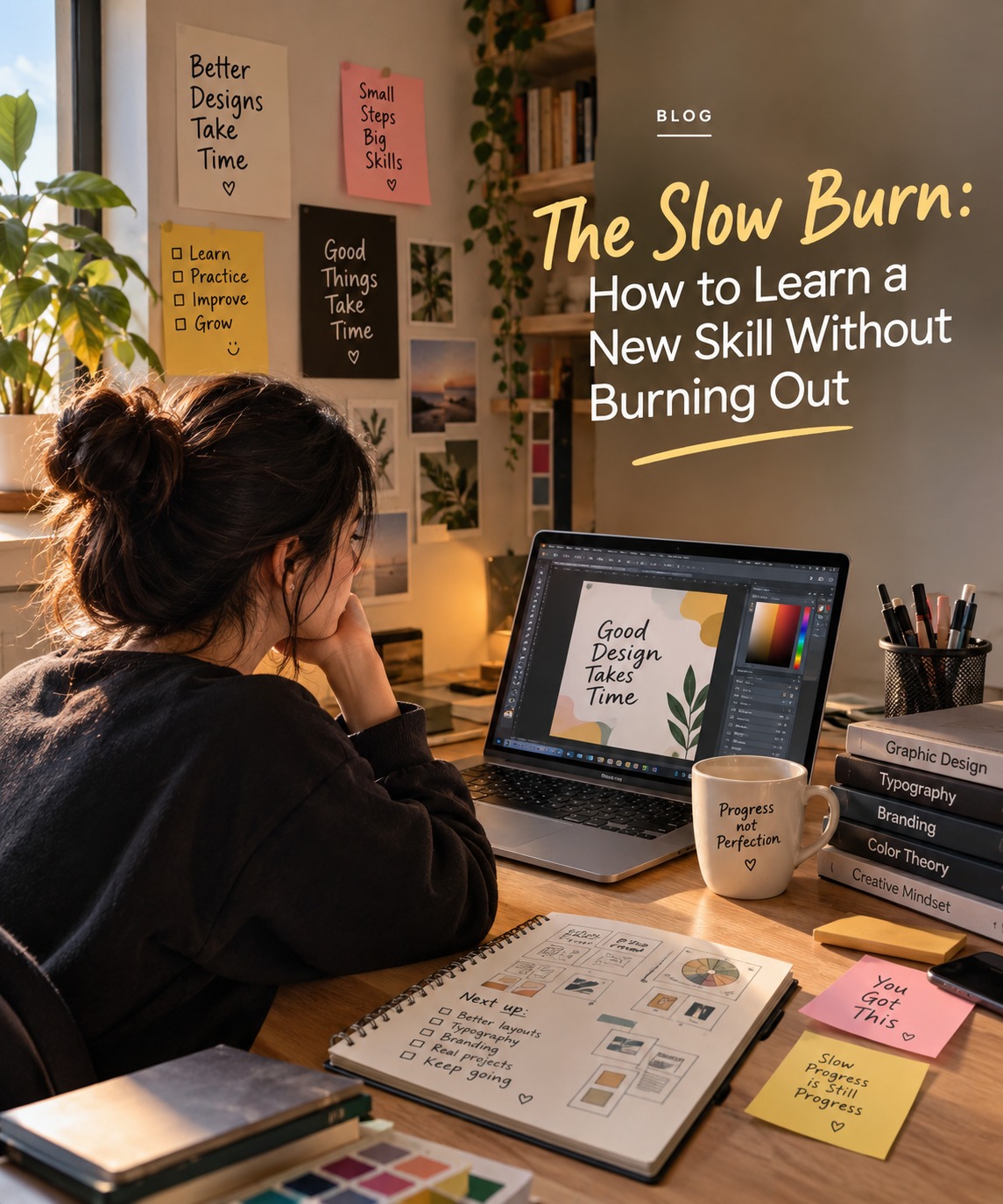
There is a kind of burnout that is born of wanting to grow, that does not have the look of overwork, but is in fact fatigue, and from the outside, it looks like ambition. The way it presents is waking up early to practice the language. It is staying up late to finish the online course. It is telling the friends that you're really pushing yourself this year. And then it hits you around week six, everything falls apart, and you're staring at the streak on this app that you no longer care to protect.
It is the strange irony of self-improvement in a culture that worships speed, that skill acquisition is a sprint, and the faster you go, the more disciplined you are. Most of the people who burn out over the course of learning something new are not lazy or undisciplined, but following a learning methodology that was never meant for the human nervous system.
The Myth of the Straight Line
Picture the productivity chart. The arrow confidently shooting to the up and right. This is how we expect everything we should want to learn to look. It is almost always wrong. What real skill acquisition looks more like is a coastline. It has stretches of flat and sudden jumps that feel almost like accidents. It has dips, where for a moment it looks like you are actually getting worse before you get better. A pianist re-learning a passage that has had a breakthrough often plays it worse the day after the breakthrough, because the brain is busy reorganizing what it has just learned. A new coder can spend three days completely stuck on a bug before finding five problems in an afternoon.
When people are expecting the arrow but get the coastline instead, they read those stretches of flat as failure. They assume the dips mean that they are actually not suited for this thing they want to learn, and they quit, not because the skill was too hard, but because the shape of their progress didn't match the shape they were promised.
Motivation Is Not a Personality Trait
There is a feeling that some people are just self-motivated, and some of us are not, as if it was some kind of eye-color that you either have or don't. In reality, motivation is a kind of weather, and it behaves more like mood than motive. It changes with the level of sleep, with the amount of stress in your life, with the interest of the material that day, with whether or not you ate lunch.
Thinking about motivation as a variable that is unpredictable rather than a moral failing when it doesn't appear, shifts the conversation to how to get around it, rather than how to shame yourself for not "feeling" it. That means asking questions like, "What would make this five percent easier to get off the ground today?" Sometimes the answers to these questions are absurdly simple things, like opening up the book to the right page the night before, or choosing to do a shorter practice session, or moving it to the morning when your willpower hasn't been spent on all the other things that you need to do at some point today.
Systems that can survive a few days of no motivation are more valuable than the ones that require you to feel motivated every day, because the days where you don't feel motivated are the majority for almost all of us.
The Cost of Invisible Effort
Burnout often comes in skill building from the fact that the effort you are putting in is invisible, and you feel like nothing is actually happening, because most of the work that your brain is doing, never comes out as something you can measure. Vocabulary is not text that the brain shouts as new, neural pathways do not send you a notification when they are strengthened. It is all massive amounts of background work, and that is the kind of work that cannot be measured, so there is nothing for you to look at when it gets done.
It is why keeping a record of some sort, is vital, not as a productivity tool, but as ammunition against your own doubt. A short note after every practice session, one sentence describing what felt different in that session, becomes something that you can look at later, when the coastlines have started turning into stretches of flat, and you think that you have just wasted your time. Two months from now, you can look back at that note, and realize, in fact, you have actually made some progress.
Rest as Part of the Skill, Not a Break From It
Most learning systems treat rest as the thing that happens after the work, the reward. But the consolidation of the skill, which is the thing that actually makes the practice that you do become the ability that you have, happens mostly through sleep and downtime, not the practice session itself. A musician doing six hours of practice a day without sufficient rest plateaus below a second musician who does three hours of practice and sleeps, because that second musician is giving their brain the time it needs to make the work of the day into something that they will remember in the long-term.
This reframes rest as infrastructure rather than indulgence. Skipping it does not make you more disciplined, it makes you less efficient, with the illusion of more effort.
Choosing Depth Over Breadth, One Season at a Time
Some of the things that burn us out over the course of learning something new is trying to do too much at once. To do everything adjacent to the skill that you are learning at once, to take up the language, study the culture and learn the grammar app and the podcast and the flashcards all at the same time, with equal energy. It is like taking every seed you ever owned, and throwing them all into the same square foot of soil.
A gentler approach is to do it in seasons. To pick one narrow part of the skill that you want to practice, and be your thing, for a certain period of time, a defined stretch of weeks, rather than days, rather than months. To let the things that are adjacent to that skill wait their turn. To do depth instead of breadth, over an extended stretch of time, before you shift.
What Endurance Actually Looks Like
People who eventually become skilled at hard things are rarely the ones who pushed the hardest from the start. They are usually the ones who found a pace slow enough that they could keep pushing to the point where the enthusiasm was enough to get them through, but not carry them beyond that point. Burnout is not always a sign that you were not suited for the skill you were trying to learn, it is almost always a sign that the pace was borrowed from someone else's life, or an unrealistic version of your own.
Learning something new, done right, doesn't feel like constant strain. It feels more like a long walk, that you can actually finish, where you stop to look back and be surprised at how far you have gotten.

Comments
Leave a Comment