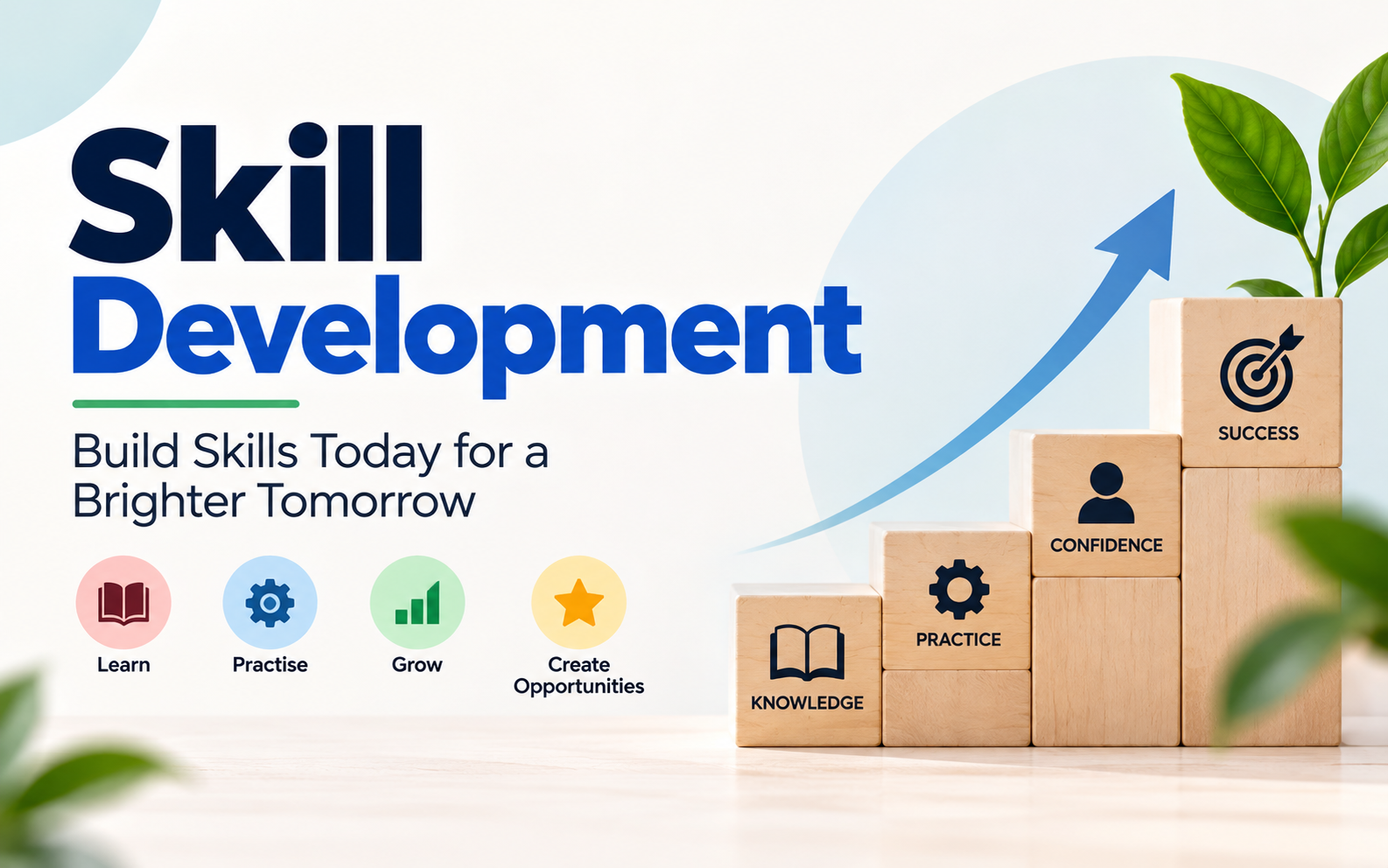
Skill Development: Turn What You Learn Into What You Can Achieve
Imagine waking up one morning and discovering that a skill you learned months ago has opened a door you never expected. Perhaps you can build a website for a local business, speak confidently during an interview, analyse data for a new project, or turn a creative idea into a source of income. These opportunities rarely appear overnight. They often begin with something small: the decision to learn, practise, and improve.
We live in a world where information is available almost everywhere. Free tutorials, online courses, digital tools, and educational communities make learning easier than ever. Yet there is a difference between knowing something and being able to use it. That difference is where skill development begins.
Instead of treating learning as a task to finish, imagine treating it as a journey in which every new ability gives you another way to solve problems, express ideas, and create opportunities.
What Does Skill Development Really Mean?
Skill development is the process of building and improving abilities through practice, experience, feedback, and continuous learning. It includes technical skills, communication, creativity, leadership, decision-making, and many other abilities that help people perform better in professional and personal life.
Consider two people who have completed the same digital marketing course. One remembers the definitions of SEO, keywords, and audience targeting. The other applies that knowledge by creating a website strategy, researching search terms, preparing content, and evaluating performance.
Both have studied the subject, but the second person has started converting knowledge into practical ability.
This is the real purpose of skill development. It is not simply about collecting certificates. It is about becoming capable of doing something useful and improving your performance with experience.
The New Career Advantage: Learn, Build, Demonstrate
Traditional education provides an important foundation, but professional growth often requires additional proof of what you can do. Employers, customers, and business partners may want to understand how you approach problems, complete tasks, and deliver results.
One effective approach is to follow three stages: learn a concept, build something with it, and demonstrate the result.
- Learn: Understand the fundamentals through books, courses, mentors, or online resources.
- Build: Apply the knowledge to a real task, personal project, or practical exercise.
- Demonstrate: Present your work through a portfolio, presentation, case study, or working example.
For example, someone interested in web development can study HTML, CSS, and JavaScript, create a responsive website, and share the finished project in a portfolio. Someone interested in content writing can practise writing articles, improve their editing skills, and publish a collection of original work.
Every completed project becomes evidence of progress. More importantly, each project reveals what you still need to learn.
Five Skills That Can Make a Meaningful Difference
1. Digital Skills: Understand the Tools Shaping Work
Digital skills are useful across industries, from education and retail to healthcare, finance, and marketing. Depending on your goals, these skills might include spreadsheets, website management, graphic design, data analysis, cybersecurity, programming, or artificial intelligence tools.
You do not need to learn every available platform. Start by identifying the tools used in your preferred field. Learn how they work, understand their limitations, and practise using them to complete actual tasks.
The advantage comes not from knowing the name of a tool but from understanding how to use it to save time, improve quality, or solve a problem.
2. Communication: Make Your Ideas Understandable
A valuable idea can lose its impact when it is poorly explained. Communication helps people share information, understand different perspectives, resolve disagreements, and work towards common goals.
Practise writing clear emails, explaining complicated topics in simple language, asking relevant questions, and listening without interrupting. If you regularly present ideas, record yourself and review your clarity, pace, and confidence.
Good communication is not about using impressive words. It is about helping another person understand what matters and what needs to happen next.
3. Critical Thinking: Look Beyond the First Answer
Problems rarely arrive with instructions explaining exactly how to solve them. Critical thinking helps you examine evidence, question assumptions, compare alternatives, and make better decisions.
Suppose an online business experiences a sudden decline in sales. Instead of immediately spending more money on advertising, a thoughtful problem-solver investigates website performance, product pricing, customer feedback, checkout difficulties, and advertising quality.
This approach encourages decisions based on evidence rather than guesswork. You can practise critical thinking by analysing everyday situations and asking three questions: What is the actual problem? What information supports my conclusion? What can I test before making a bigger decision?
4. Creativity: Discover More Than One Solution
Creativity is not limited to painting, music, or design. It also appears when someone finds a simpler process, develops a new business idea, improves a customer experience, or explains a difficult concept in an interesting way.
Develop this ability by exploring different perspectives, experimenting with new approaches, and allowing yourself to make imperfect first attempts. When an idea does not work, examine why it failed and what could be changed.
Sometimes, the most useful innovation is not a completely new invention. It is an existing solution made simpler, faster, more affordable, or easier to use.
5. Adaptability: Stay Ready for Change
Industries evolve, job responsibilities change, and technology introduces new ways of working. Adaptability helps you respond without becoming dependent on one method or one set of tools.
Build this skill by exploring unfamiliar tasks, learning from constructive criticism, and updating your knowledge when circumstances change. You do not have to follow every trend. Instead, identify developments that are relevant to your goals and learn how to respond to them thoughtfully.
Being adaptable does not mean abandoning your strengths. It means learning how to apply those strengths in new situations.
The 30-Day Skill Challenge: From Beginner to Practical Learner
One reason people struggle with skill development is that their goals are too broad. Saying “I want to learn technology” or “I want to improve my communication” provides direction, but not a clear action plan.
A more effective approach is to choose one specific ability and work towards a practical outcome over 30 days.
Week 1: Build Your Foundation
Choose one skill and understand its basic principles. Select a reliable learning resource, establish a realistic daily schedule, and identify what you want to accomplish by the end of the month.
For example, if you choose graphic design, your target might be to create a small collection of professional social media posts.
Week 2: Practise With Purpose
Move beyond passive learning. Complete small exercises, repeat difficult tasks, and focus on areas where you make mistakes. Keep a simple record of what you have practised and what still feels challenging.
Week 3: Create a Real Project
Use your developing ability to create something meaningful. Write an article, design a poster, build a basic website, prepare a budget spreadsheet, or deliver a short presentation.
A project gives your learning direction because you have a clear outcome to work towards.
Week 4: Review, Improve, and Share
Ask a knowledgeable person to review your work. Identify weaknesses, make improvements, and compare the final result with your first attempt.
Save your work in a portfolio or personal learning folder. Even if the result is not perfect, it becomes a starting point for your next project.
Thirty days will not turn every beginner into an expert, but a focused month can establish a strong learning habit and produce visible progress.
How to Choose a Skill That Matches Your Goals
Not every popular skill deserves your time. The right choice depends on your interests, career plans, available resources, and the problems you want to solve.
Before enrolling in a course, consider the following questions:
- Will this skill help me perform better in my current role or move towards a desired career?
- Can I practise it regularly with the time and resources available to me?
- Can I create a project that demonstrates my progress?
- Does it complement the abilities I already possess?
- Is there evidence that this skill is relevant to my chosen industry?
Look at job descriptions, project requirements, customer needs, and feedback from experienced professionals. These can help you identify which abilities deserve priority.
You can also combine complementary skills. Writing and data analysis may support content strategy, while design and marketing can work together in brand development. A technical professional with strong communication skills may be better equipped to explain complex solutions to clients.
Your goal should be to build a useful combination of abilities rather than chase every new trend.
Common Mistakes That Prevent Progress
Learning everything at once: Switching constantly between unrelated subjects can leave you with incomplete knowledge. Focus on one priority before adding another.
Watching without practising: Tutorials are useful, but they cannot replace hands-on experience. Apply what you learn as soon as possible.
Waiting to feel ready: Confidence often develops through practice rather than appearing before it. Start with manageable projects and improve gradually.
Ignoring feedback: Repeating the same task without reviewing your mistakes can slow improvement. Ask for constructive criticism and act on it.
Comparing your beginning with someone else's experience: Every professional has a different starting point. Measure your progress against your previous performance instead of expecting immediate mastery.
Build a Personal Skill Portfolio, Not Just a Resume
A resume describes your qualifications and experience, but a personal skill portfolio can show how you apply your knowledge. It might include completed projects, designs, writing samples, presentations, certifications, or case studies explaining how you approached a problem.
Keep the portfolio organised and update it as your abilities improve. Include your strongest work and explain your contribution honestly. If a project involved a team, clearly describe the part you completed.
This practice also benefits you personally. Looking back at earlier work helps you recognise improvement, understand recurring weaknesses, and decide what to learn next.
Think of your portfolio as a record of progress rather than a display of perfection. Every project tells a small story about what you attempted, what you discovered, and how you developed.
Conclusion: Your Next Opportunity May Begin With One Skill
Skill development is not a race to collect qualifications or become an expert in every subject. It is a steady process of becoming more capable, independent, and prepared for new challenges.
Start with one useful skill. Make time to practise it, create something with what you learn, and use feedback to improve your work. When you have built a solid foundation, choose the next ability that supports your goals.
You may not see dramatic results in a single day, but small improvements can accumulate into meaningful progress over time.
Instead of asking only, “What did I learn today?” ask yourself, “What can I do today that I could not do before?”
That question turns learning into action, action into experience, and experience into a foundation for future opportunities.
Comments
Leave a Comment