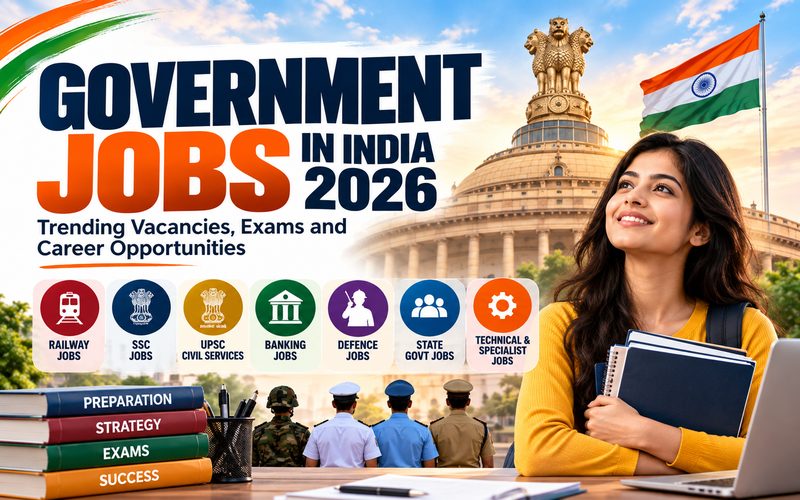
Government Jobs in India 2026: Trending Vacancies, Exams and Career Opportunities
Every year, millions of young Indians prepare for government jobs. Some study for competitive exams after Class 12, some start preparing during college, and others leave private-sector jobs to look for a more stable career.
For many families, a government job represents more than a monthly salary. It can mean financial independence, career growth, social respect and the ability to plan for the future.
But there is one question almost every aspirant asks: Which government jobs should I prepare for in 2026?
The answer depends on your educational qualification, interests, age, skills and the kind of work you want to do. Graduates interested in administration may consider SSC or UPSC examinations, while candidates with technical qualifications can explore railway or departmental recruitment. Those interested in uniformed services may consider defence and police opportunities.
Government recruitment also covers engineers, accountants, scientists, medical professionals, cybersecurity specialists and technical staff. Let's explore popular recruitment sectors, how to find genuine vacancies and how to prepare effectively.
1. Why Government Jobs Remain Popular in India
Ask ten government job aspirants why they want a sarkari naukri, and you may hear ten different answers. Some want a dependable income, others want to support their families, and many are interested in public service.
- Salary and benefits: Many positions offer structured pay scales, allowances and other benefits under applicable service rules.
- Career progression: Employees may receive opportunities for promotion, training and greater responsibilities.
- Employment stability: Regular government employment can provide greater stability, subject to service rules.
- Different educational pathways: Opportunities may be available after Class 10, Class 12, graduation, diplomas or professional qualifications.
- Public service: Government employees contribute to education, healthcare, infrastructure, public safety and administration.
However, government jobs are not automatically easy or suitable for everyone. Recruitment can involve competitive examinations, physical tests, interviews, document verification and long waiting periods. Choose a career that matches your interests and strengths instead of following a trend blindly.
2. Trending Government Job Opportunities in October 2026
Government recruitment takes place across multiple sectors. The following are important areas for aspirants to monitor. Always verify current vacancies and application deadlines through the relevant official notification.
Railway Recruitment Board (RRB)
Indian Railways recruits candidates for technical, operational, administrative and non-technical positions. Depending on the notification, opportunities may include:
- Junior Engineer (JE)
- Non-Technical Popular Categories (NTPC)
- Technician
- Assistant and other operational posts
- Depot Material Superintendent
- Chemical and Metallurgical Assistant
RRB NTPC Graduate recruitment under CEN No. 06/2026 was reported to cover 3,548 vacancies. Candidates should verify the vacancy count, application status and eligibility in the relevant official notice.
Technical positions may require specific qualifications, while non-technical positions have different eligibility conditions. Check age limits, medical standards, examination stages and educational requirements before applying.
Official website: Railway Recruitment Board
Staff Selection Commission (SSC)
SSC examinations are popular recruitment routes for central government positions. Depending on the examination and notification, candidates may explore:
- Combined Graduate Level (CGL)
- Combined Higher Secondary Level (CHSL)
- Multi-Tasking Staff (MTS)
- General Duty Constable (GD)
- Central Police Organisation (CPO)
- Stenographer
- Selection Posts
SSC CGL is generally intended for eligible graduates, while CHSL offers opportunities for eligible Class 12 candidates. MTS and other examinations have their own educational and age requirements.
The SSC examination calendar can help candidates plan their preparation, but a calendar entry does not necessarily mean applications are open. Confirm application dates and examination updates on the official website.
Official website: Staff Selection Commission
UPSC Recruitment and Civil Services
The Union Public Service Commission (UPSC) is widely known for the Civil Services Examination, which recruits eligible candidates for services such as the IAS, IPS and other notified services.
UPSC also conducts examinations and direct recruitment for specialised positions in government departments. Some roles require professional qualifications, relevant experience or specialised knowledge.
For Civil Services aspirants, preparation involves understanding the examination structure, general studies, current affairs, aptitude and other applicable requirements. Direct recruitment follows the selection process specified for each advertised position.
Do not assume that every UPSC vacancy is for IAS or IPS. Always read the exact post title and eligibility conditions.
Official websites:
Banking and Financial-Sector Jobs
Banking jobs attract graduates interested in finance, customer service, operations, risk management and administration. Recruitment opportunities may arise through public-sector banks, IBPS, SBI, RBI and other financial institutions.
- Probationary Officer
- Customer Service Associate or clerk-level positions
- Specialist Officer
- Assistant
- Credit and risk-related positions
- IT and cybersecurity specialists
Eligibility requirements vary. General banking examinations may test reasoning, quantitative aptitude, English and banking awareness. Specialist positions may require particular degrees, professional qualifications or relevant experience.
Official websites:
Defence and Uniformed Services
Candidates interested in physically active careers and defined responsibilities may explore recruitment in the Indian Army, Indian Navy, Indian Air Force, Indian Coast Guard, central armed police forces and state police services.
Depending on the entry route, roles may involve officer training, technical work, operational duties, security, communications or logistics. Some entries accept eligible Class 12 candidates, while others require graduation or specific technical qualifications.
Age requirements, physical fitness, medical standards and selection procedures are particularly important in this sector. Read the official notification carefully before beginning preparation.
Government Technical and Specialist Vacancies
Not every government job requires preparation for a general competitive examination. Government departments, public-sector enterprises and government-funded institutions also recruit engineers, accountants, medical professionals, researchers, teachers, IT specialists and administrators.
Candidates with relevant degrees, diplomas, professional licences or work experience should explore specialised recruitment opportunities that match their qualifications.
Check whether each position is permanent, contractual, temporary or deputation-based. Employment with a government organisation does not automatically mean that every advertised position is a permanent government post.
Official recruitment resource: Employment News
3. Which Government Jobs Can You Consider After Class 10, Class 12 or Graduation?
After Class 10
Depending on the notification, eligible candidates may explore selected MTS, support staff, trade, apprentice and entry-level opportunities. Some technical positions require an ITI certificate or another specific qualification. Apprenticeships may have different terms from regular employment.
After Class 12
Candidates may investigate SSC CHSL, eligible railway positions, selected defence entries, state recruitment and other posts accepting Class 12 qualifications. Typing skills, physical fitness or technical certificates may be required for certain roles.
After Graduation
Graduates can explore SSC CGL, Civil Services, banking examinations, graduate-level railway recruitment, state public service commissions and specialised departmental vacancies. Eligibility depends on the specific post, age limit, educational background and other requirements.
After a Professional or Technical Qualification
Engineers, doctors, lawyers, accountants, scientists and IT professionals can look for recruitment related to their areas of expertise. Specialised roles may offer a more direct match between existing skills and job responsibilities.
4. How to Find Genuine Government Job Notifications
Multiple websites publish government vacancy news, but not every headline is complete, current or accurate. Follow these steps before applying:
- Identify the recruiting organisation: Confirm whether the vacancy is advertised by SSC, UPSC, an RRB, a bank, a state commission or another institution.
- Read the official notification: Check the advertisement number, post title, vacancy count, eligibility and application instructions.
- Verify the dates: Confirm the application deadline, examination date, fee deadline and correction window.
- Review eligibility: Check age limits, relaxations, educational qualifications, nationality and experience requirements.
- Apply through the authorised portal: Save your registration details and application confirmation securely.
You can also explore employment information through the National Career Service portal.
Be cautious of anyone demanding money in exchange for a guaranteed government appointment. Competitive recruitment does not offer legitimate guaranteed selection through private agents.
5. How to Prepare for Government Exams Without Burning Out
Government exam preparation can become exhausting when candidates try to study everything at once. A realistic plan helps you maintain consistency.
Choose One Primary Examination
You can explore related opportunities, but prioritise examinations with compatible syllabuses. Preparing for several unrelated examinations at the same time can divide your attention.
Understand the Syllabus
Download the official syllabus and examination pattern. Identify the subjects, question types, marking scheme and selection stages before creating your study plan.
Create a Practical Daily Schedule
Divide your available time between core subjects, revision, current affairs and mock tests. If you are working or attending college, start with a schedule you can maintain consistently.
Practise Previous Question Papers
Previous papers help you understand question patterns, difficulty levels and time pressure. Review incorrect answers to identify knowledge gaps, calculation errors and time-management problems.
Revise Regularly
Maintain concise notes for formulas, important facts, vocabulary and recurring mistakes. Use reliable sources for current affairs instead of trying to memorise every news story.
Protect Your Health
Sleep, exercise and breaks matter. An achievable routine is more useful than an unrealistic timetable that lasts only a few days.
6. Government Job Preparation in the Age of AI
AI-powered study tools can help explain difficult concepts, generate practice questions, organise revision notes and simulate interview questions. Educational videos and online test platforms can also make preparation more accessible.
However, AI-generated answers can contain mistakes, and practice questions may not match the official examination pattern. Use technology as a learning assistant, not as a replacement for official syllabuses and authentic previous papers.
Candidates should also develop practical digital skills, including typing, document preparation, spreadsheet basics and online application literacy where relevant to their chosen roles.
7. Common Mistakes Government Job Aspirants Should Avoid
- Preparing for every examination: Constantly switching between unrelated syllabuses can slow your progress.
- Trusting every vacancy headline: Some headlines omit eligibility restrictions or refer to old recruitment cycles.
- Ignoring application deadlines: Missing the registration deadline can prevent you from participating.
- Submitting forms carelessly: Incorrect personal details, photographs, signatures or documents can create problems.
- Neglecting mock tests: Knowing the syllabus is not the same as completing an examination within the time limit.
- Paying for guaranteed selection: No agent or coaching centre can legitimately guarantee success in a competitive recruitment process.
- Comparing your journey with others: Focus on your progress and realistic goals rather than someone else's timetable.
8. A Simple Government Job Action Plan for October 2026
If you want to start now, follow this practical checklist:
- Write down your highest qualification, age and relevant professional skills.
- Select one main examination or recruitment category.
- Identify two or three related opportunities with compatible eligibility requirements.
- Check official websites for active notifications and upcoming examination schedules.
- Download the syllabus and create a weekly study plan.
- Set aside time for practice tests and revision.
- Keep your documents ready and verify application details before submission.
- Review your progress at the end of each week.
If you already have an application in progress, prioritise the next official milestone, such as an admit card, examination, skill test or document verification. Do not submit duplicate applications unless the official instructions permit or require it.
Conclusion: Your Government Job Journey Starts With the Right Information
Government jobs in India offer a wide range of career possibilities, from administration and banking to railways, defence, engineering, research and specialised departmental work.
Developments involving railway recruitment, SSC examinations, UPSC direct recruitment and specialist departmental vacancies give candidates several areas to monitor. However, the right opportunity is not necessarily the one with the biggest headline or the largest vacancy count.
It is the one for which you meet the eligibility requirements, understand the selection process and can prepare realistically.
Start by checking official notifications. Choose a clear target, follow a consistent study routine, practise previous papers and stay alert to deadlines.
A government job is a career goal, not a shortcut to instant success. Preparation takes effort, patience and sometimes more than one attempt.
The first step towards a government job is not filling out an application. It is finding the right opportunity and understanding what it takes to qualify.
Disclaimer: Recruitment details, vacancy counts and deadlines may change. Always consult the latest official notification before applying. This article is intended for general career information.
Comments
Leave a Comment