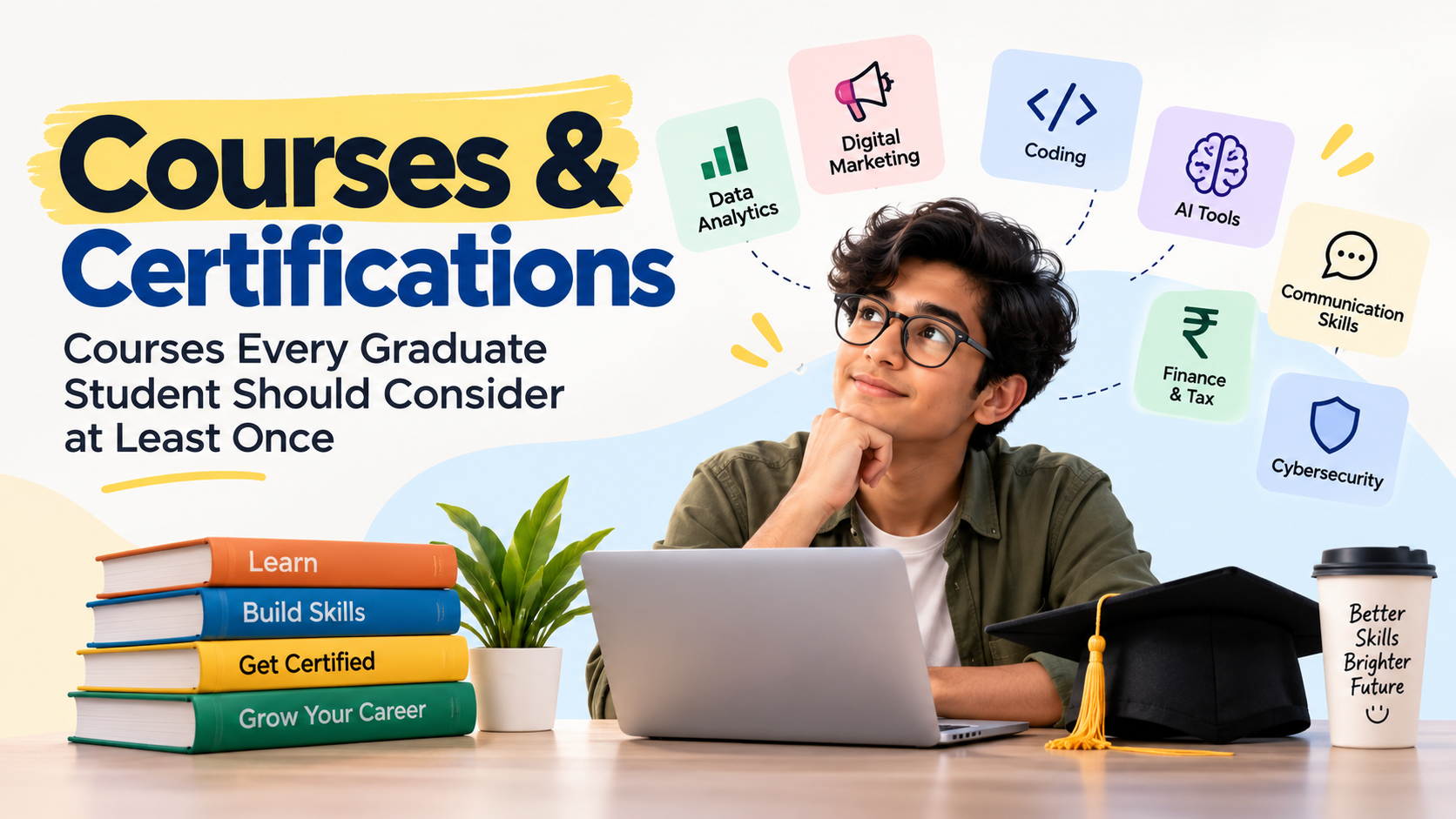
Courses & Certifications: Courses Every Graduate Student Should Consider at Least Once
There is a strange moment after graduation.
You have spent years attending lectures, writing assignments, sitting for exams and waiting for that final result. Then suddenly, the degree is in your hand and everyone starts asking the same question:
"Now what?"
For some graduates, the answer is obvious. They already have a job offer. Others start preparing for government exams, applying for internships or thinking about higher studies. And then there is another group that spends months trying to figure out what employers actually expect from them.
This is where courses and certifications can help.
A degree gives you an academic foundation. A good course can help you turn that foundation into something practical. Sometimes it teaches you a technical skill. Sometimes it helps you communicate better, understand business, work with data, manage money or simply become more comfortable with tools that companies use every day.
You do not need to collect twenty certificates.
One well-chosen course that you actually understand and can use may be more useful than a folder full of certificates you barely remember.
That is the idea behind this guide.
Here are some online and offline courses that many graduates can consider at least once during their early career.
Why Should Graduates Take Additional Courses?
A college degree can open the door to opportunities, but the workplace often asks a different set of questions.
Can you make a presentation?
Can you analyse a spreadsheet?
Can you write a professional email?
Can you explain an idea clearly?
Can you use common digital tools?
Can you work with data?
Can you manage a project?
Can you understand basic finance?
Can you use AI tools without depending on them for everything?
These are practical skills.
Some colleges teach them directly. Some do not.
That is why additional learning has become such a normal part of starting a career.
The good part is that learning no longer means joining a classroom every evening. You can learn from a laptop, a phone or an actual training centre depending on your preference.
1. Excel and Spreadsheet Skills
Start here.
Seriously.
A surprising amount of office work still revolves around spreadsheets.
Whether you enter sales data, prepare reports, compare expenses, maintain employee information or create a monthly business tracker, Excel can end up on your screen.
Graduates should understand at least the basics of:
- Formulas
- Sorting and filtering
- Conditional formatting
- Charts
- Pivot tables
- Data cleaning
- Lookup functions
- Basic dashboards
You do not need to become an Excel wizard on day one.
But being comfortable with spreadsheets can make everyday office work much easier.
An online beginner-to-intermediate course is enough for many students to get started. Offline computer-training institutes can also work well for students who prefer learning with an instructor.
2. Digital Marketing
Digital marketing is another practical skill that graduates from almost any background can explore.
You could study:
SEO, social media marketing, content marketing, email marketing, paid advertising, analytics or basic marketing strategy.
What makes this course interesting is its flexibility.
A commerce graduate can use it.
A management student can use it.
A design student can use it.
Even someone from a completely different academic background can learn the basics and use them for a side project or small business.
The useful part of a digital-marketing course is not memorising definitions. It is learning how businesses actually attract customers online.
Try building something while learning. A small Instagram page, a blog, a mock campaign or a simple website gives the lessons somewhere to live.
3. Data Analytics
You do not have to become a data scientist to benefit from learning data analysis.
For many graduates, an introductory data-analytics course can be a useful bridge between traditional academic knowledge and modern workplace requirements.
A beginner course may introduce:
- Excel
- SQL
- Data visualisation
- Statistics
- Power BI
- Tableau
- Basic Python
The right course depends on your career plans.
Someone targeting business roles may focus more on Excel, dashboards and business reporting.
Someone interested in technical analytics may eventually move towards SQL and Python.
The key is to start with the level you can handle.
There is no need to jump into advanced programming on your first weekend.
4. Communication Skills
This one is easy to underestimate.
A graduate may know the subject well and still struggle in meetings, interviews or professional conversations.
Communication courses can help with:
Public speaking, business writing, presentations, interview communication, workplace English and professional etiquette.
And there is something important here: communication is not just about speaking fluent English.
It is about getting your point across.
Can you explain a problem without going in circles?
Can you write an email that another person understands immediately?
Can you present your work without reading every line from the screen?
Can you disagree with someone professionally?
Those skills stay useful long after the certificate itself is forgotten.
5. Project Management
You do not need to be a project manager to learn project management.
In fact, graduates in many careers eventually work on projects.
A project could be a marketing campaign, website launch, office event, product update, research assignment or software release.
A basic project-management course can introduce concepts such as:
- Planning
- Timelines
- Task allocation
- Risk management
- Team coordination
- Documentation
- Project tracking
Tools such as Trello, Asana, Jira or Microsoft Project may also appear in practical training.
For students entering consulting, operations, technology, marketing or management-related roles, these ideas can be particularly useful.
6. Basic Coding and Programming
Not every graduate needs to become a software developer.
Still, learning basic coding can be useful even when programming is not your main career path.
You could start with something approachable such as:
- HTML and CSS for websites
- Python for basic programming and data work
- JavaScript for web development
- SQL for databases
The real benefit is learning how digital systems work.
Once you understand basic coding logic, software tools can feel less mysterious.
You may even find that you enjoy it enough to turn a basic course into a new career direction.
7. AI Tools and Generative AI
This is one of the newer areas graduates should understand.
AI tools are already being used for tasks such as writing drafts, brainstorming, summarising information, analysing data, generating images, preparing presentations and assisting with coding.
That does not mean a graduate should depend on AI for every task.
A useful course should teach you how to:
- Write better prompts
- Check AI-generated information
- Use AI for research and productivity
- Protect sensitive information
- Work with AI-assisted writing and coding tools
- Integrate AI into normal workflows
The strongest skill is not simply knowing how to type a prompt.
It is knowing when AI is useful, when it is unreliable and when you need your own judgment.
8. Graphic Design
Creative skills can be surprisingly useful in ordinary jobs.
You might be asked to make a social post, presentation cover, basic brochure, internal announcement or marketing visual.
A beginner graphic-design course can introduce tools such as Canva, Photoshop, Illustrator or other design software.
You do not have to become a professional designer.
Learning basic layout, spacing, typography, image selection and colour use can make your work look much more polished.
Students interested in marketing, content, social media, events and entrepreneurship may find this especially helpful.
9. Video Editing
Short-form video has changed how businesses communicate online.
Companies use videos for social media, product demonstrations, training, advertising, presentations and internal communication.
A basic editing course can teach:
- Cutting clips
- Adding captions
- Working with audio
- Transitions
- Basic colour correction
- Motion graphics
- Export settings
You could start with a simple editing tool and move to more advanced software later.
Again, the goal does not have to be a career in filmmaking.
Being able to make a clean, useful video is already a practical workplace skill.
10. Financial Literacy
Every graduate should understand money.
That includes graduates who never studied finance.
A basic financial-literacy course can cover:
- Budgeting
- Banking
- Interest
- Loans
- Credit cards
- Insurance
- Taxes
- Investments
- Emergency funds
- Retirement planning
You do not need to become an investor immediately after taking such a course.
The purpose is simply to understand what happens to your salary once it reaches your bank account.
Knowing the difference between saving and investing, understanding loan interest and recognising common financial mistakes can be valuable throughout adult life.
11. Tax Basics
Graduation is also a good time to learn the basics of taxation.
This becomes especially useful once you start earning.
A beginner tax course can introduce concepts such as:
- Income tax
- TDS
- ITR filing
- Tax deductions
- GST basics
- Capital gains
- Tax documents
- Tax planning
You do not need to become a tax professional.
You should simply know enough to understand your own financial responsibilities and recognise when professional help may be required.
12. Cybersecurity Awareness
You probably use online banking, social media, email, cloud storage and mobile applications every day.
That makes basic cybersecurity knowledge useful for almost everyone.
A beginner course can explain:
- Phishing
- Passwords
- Multi-factor authentication
- Malware
- Social engineering
- Data privacy
- Safe browsing
- Device security
It may not sound like the most exciting course on a college noticeboard.
But knowing how scams work can prevent a very unpleasant phone call to your bank later.
13. Business and Entrepreneurship Courses
Not every graduate wants a traditional office job.
Some want to start a business. Others may eventually work with clients, launch a side project or join a startup.
A basic entrepreneurship course can teach you about:
- Business models
- Customer research
- Pricing
- Sales
- Marketing
- Business finance
- Operations
- Basic legal considerations
Entrepreneurship courses are most useful when paired with a real idea.
Create a small project while learning.
Sell something.
Build a simple website.
Try a service.
Interview potential customers.
That experience often teaches lessons that a classroom discussion cannot.
14. Sales and Negotiation
Sales is not only for salespeople.
You negotiate salaries.
You negotiate deadlines.
You explain ideas to clients.
You ask for resources from colleagues.
You may eventually manage vendors, partnerships or customers.
A sales or negotiation course can teach practical concepts such as:
- Listening
- Questioning
- Handling objections
- Presenting value
- Negotiating terms
- Closing conversations
- Following up
The better you understand how people make decisions, the more comfortable many professional conversations become.
15. Human Resource Management
Students interested in people-facing careers may consider an HR course.
An introductory course can cover:
- Recruitment
- Interviewing
- Onboarding
- Employee relations
- Performance management
- Training
- Workplace policies
- HR technology
This can be useful for graduates aiming for HR roles, but the concepts also help managers understand how teams are built and supported.
16. Supply Chain and Logistics
India's growth in e-commerce, manufacturing, retail and infrastructure has increased attention on logistics and supply-chain work.
Students interested in operations can explore courses covering:
- Procurement
- Inventory management
- Warehousing
- Transportation
- Demand forecasting
- Vendor management
- Supply-chain planning
This area can lead into very practical careers because businesses constantly need products to move from one place to another efficiently.
17. UI/UX Design
For creative and technology-minded graduates, UI/UX can be an interesting field.
UI focuses on how an interface looks.
UX focuses more broadly on how the user experiences the product.
Courses may cover:
- User research
- Wireframes
- Prototypes
- Design systems
- Usability testing
- Interface design
Tools such as Figma are commonly used in modern design workflows.
You can learn a surprising amount by redesigning everyday applications as practice projects.
18. Cloud Computing
Cloud computing is another technical field worth exploring, especially for computer-science and IT graduates.
Beginner courses can introduce services and concepts related to:
- Servers
- Storage
- Databases
- Networking
- Cloud security
- Deployment
- Scalability
Major cloud platforms have their own learning resources and certification programmes.
For students planning technology careers, an entry-level cloud course can provide useful context before moving into more advanced certifications.
19. Cybersecurity as a Career Skill
Basic security awareness and professional cybersecurity are two different things.
A graduate interested in cybersecurity can go much deeper through specialised courses covering:
- Network security
- Ethical hacking
- Security operations
- Vulnerability assessment
- Digital forensics
- Identity and access management
- Security compliance
These courses require more commitment than a basic awareness class, but they can form part of a serious technical career path.
Choose training based on the level you actually want.
There is no benefit in buying an advanced certification and discovering halfway through that you skipped the fundamentals.
20. Language Courses
Learning another language can be useful academically, professionally or personally.
Depending on your interests, you might study:
- German
- French
- Spanish
- Japanese
- Korean
- Mandarin
- Arabic
- Or another language relevant to your plans.
The biggest mistake is expecting a certificate after a few weeks to mean fluency.
Language learning takes repetition.
Use the language, listen to it, read it and speak it regularly.
A certificate can document your level. It cannot replace the ability to communicate.
21. Offline Courses Still Have a Place
Online education gets most of the attention, but offline classes still make sense for many students.
Some people learn better when there is an instructor in front of them.
Offline courses can be particularly useful for:
- Technical lab training
- Hardware and networking
- Electrical work
- Healthcare-related practical training
- Hospitality
- Fashion and tailoring
- Photography
- Communication practice
- Hands-on software workshops
The biggest advantage is immediate interaction.
You can ask a question, watch someone demonstrate a process and try it yourself.
For practical subjects, that can make a big difference.
22. Online Courses Give You More Flexibility
Online learning has another advantage: you can fit it around your life.
A student can take a course after college.
A working professional can study at night.
Someone preparing for another exam can learn at their own pace.
Online platforms offer courses ranging from short introductions to long professional programmes.
The quality varies, though.
Before enrolling, check:
- Who teaches the course?
- What will you actually learn?
- Does it include projects?
- Is there an assessment?
- What does the certification represent?
- Are the course materials current?
A flashy course page is not the same thing as a good course.
23. Certificates Are Useful, But Skills Matter More
This may be the most important point in the entire article.
Imagine two graduates.
One has fifteen certificates but cannot confidently use Excel, explain a project or solve a basic practical problem.
The second has three certificates and a portfolio showing actual work.
The certificates tell only part of the story.
A certificate can show that you completed training or passed an assessment. What matters beyond that is whether you can use what you learned.
So after every course, ask yourself:
"What can I do now that I could not do before?"
That is a much better measure of learning.
24. Build a Small Portfolio
A portfolio gives your learning somewhere to go.
Finished an Excel course?
Create a sales dashboard.
Completed a digital-marketing course?
Build a mock campaign.
Studied data analytics?
Analyse a public dataset.
Learned graphic design?
Create five sample posters.
Studied web development?
Build a simple website.
Completed a video-editing course?
Create a short edited video.
A project turns a certificate into evidence.
When someone asks what you learned, you do not have to explain for ten minutes.
You can simply show them.
25. Don't Take Every Course You See
There is a strange trap in online learning.
Because courses are cheap, easily available and constantly advertised, it is tempting to keep enrolling.
One course in digital marketing.
Then SEO.
Then social media.
Then analytics.
Then AI.
Then another digital-marketing course because it is 80% off.
Soon you have spent months collecting courses instead of completing them.
Pick one skill.
Learn it properly.
Practice.
Then move on.
Progress usually comes from depth before quantity.
How to Choose the Right Course
Before paying for a course, spend five minutes checking what you are actually buying.
Start with the learning outcome.
What will you be able to do after completing it?
Then look at the instructor.
Do they have practical experience in the subject?
Next, look for hands-on work.
Projects, assignments and exercises are valuable because they force you to use the concepts.
Also check the course level.
A beginner does not need an advanced programme just because the certificate sounds impressive.
Finally, consider the time commitment.
A course that takes three months is a different commitment from a six-hour introductory course.
Choose according to your goal, not according to the size of the certificate.
A Simple Course Plan for Graduates
You do not need to study everything mentioned above.
A sensible starting combination could be:
One workplace skill: Excel, communication or presentation skills.
One technology skill: AI tools, coding, data analytics or cybersecurity.
One career skill: Digital marketing, project management, sales or finance.
One personal skill: Financial literacy, language learning or another area you genuinely enjoy.
That gives you a balanced foundation without turning learning into a second full-time degree.
Final Thoughts
Graduation is not the end of learning.
For many people, it is the point where learning finally becomes more personal.
College teaches you what is included in the curriculum.
Your next courses can be chosen around the person you want to become professionally.
Maybe that means learning Excel because your first job requires it.
Maybe it means digital marketing because you want to work with brands.
Maybe you learn Python because technology interests you.
Maybe you study finance because you want to understand your own money.
Maybe you take a communication course because you know you have good ideas but struggle to explain them.
There is no universal list that every graduate must complete.
The useful approach is to choose skills that connect with real life.
One course can help you get better at your current job.
Another may introduce you to an entirely new career.
And occasionally, a simple weekend course can reveal an interest you never knew you had.
That is one of the best things about learning after graduation.
You are no longer studying only because there is an exam next month.
You are learning because you have somewhere to use the knowledge.
And that changes everything.
A certificate can sit in a folder. A useful skill stays with you.
Comments
Leave a Comment